










Dear Pike & Perch readers,
My name is Lieske Meiners and I'm from the lovely city of Oldenburg in Lower Saxony. I'm a member of the Pike & Perch team, and this is my very first blog post — so please be gentle with me.
What Is the Carolina Rig?
I've been lure fishing for four years now, and it's perch that have truly captured my heart. So today I want to talk about my favourite alternative to standard jigging for perch: fishing with a Carolina rig.
It's particularly brilliant in snag-heavy spots with lots of weed or rocks, and in winter when fish are lethargic on the bottom and prefer a slow presentation. Even with heavier weights, the soft lure sinks almost weightlessly — and that makes all the difference. On top of that, you can work it with jigging and slow hops, or simply drag it along the bottom.
As well as giving you excellent bottom feedback, the sediment cloud the weight kicks up draws predators in and often triggers those first bites. I use this rig mainly for perch, but it works just as well for zander and pike, consistently producing good catches. Since I usually fish with a single rod but a wide range of lures, I fish a slightly modified version of the Carolina rig that lets me adapt quickly to changing conditions on the bank — swapping lures without retying every time.
In the colder months especially, it's proved its worth to be able to switch instantly from small soft lures to larger ones, or change weights, and react to short bite windows — not to mention the benefits when your fingers are numb with frost.
When to Use the Carolina Rig
The Carolina rig is well suited for:
- snag-heavy areas
- strong currents
- lethargic fish
- when you need long casts with light lures
- winter fishing
- very high or very low water temperatures
- heavily weeded waters
Tying the Modified Carolina Rig
Here's how I tie my version of the Carolina rig, step by step:
What You'll Need
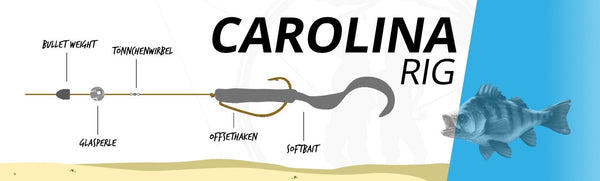
Start with the standard Carolina rig components: a bullet weight (I use 7–18 g in lead or tungsten) with a matching glass bead, and offset hooks in various sizes (for example, size 2/0 for 4-inch lures, and size 2 to 3 for smaller ones). What makes this version special is the addition of a snap (I go for very small but extra-strong snaps in size #00 or #000), two fluorocarbon lines of different diameters (I use between 0.22 and 0.35 mm when fishing for perch), and two barrel swivels (size 18 to 20) as connectors. Instead of barrel swivels, you can also use a loop knot. The advantage of barrel swivels is a more direct connection, which makes bites easier to detect and striking more effective. They also cancel out any line twist from the lure as it works.
Summary of Materials Required:
- offset hook
- bullet weight
- glass bead
- fluorocarbon line (two different diameters)
- high-power mini snap
- high-power mini barrel swivels (size 18 to 20), two pieces
Step-by-Step Tying Guide
Step 1:
Tie the first barrel swivel to one end of the thinner fluorocarbon (e.g. 0.22 mm) using a suitable knot. At the other end, tie on your offset hook. This becomes the front section of the leader — the length is entirely up to you. In my experience, I prefer a slightly longer leader in winter, around 45 to 55 cm. This creates a longer sink time for the lure, which lethargic perch in cold conditions often respond to well. A longer leader also makes it easier for fish to inhale the lure; a shorter one improves bite detection — but striking the right balance is a matter of personal preference. The first part of the rig is now complete. You can repeat this process with different hook sizes or line diameters, depending on what each lure requires (see Fig. 1, left side).
Step 2:
Take the thicker fluorocarbon (e.g. 0.28 mm) and tie the snap to one end. This is where you'll later clip in the barrel swivel or loop knot from Step 1. Thread on the glass bead, followed by the bullet weight in your chosen size. Finally, tie the second barrel swivel to the other end. This then clips onto the snap on your main line (see Fig. 1, right side). The length of this section isn't critical — just make sure the glass bead has enough room to click against the bullet weight when you jig it. I usually go for around 20 cm. That completes the second part of the rig.
Combining and Varying the Rig
Out on the water, the right bullet weight will vary depending on whether you're fishing a river or a lake. Because you've built two independent sections, all parts can be mixed and matched freely.
If you're fishing a water with plenty of perch and want to target the bigger ones, clip in the front section with the larger offset hook, which takes bigger lures. If that doesn't produce, you can quickly switch to smaller lures by swapping to the front section with the smaller hook.
It's just as simple and quick to change the bullet weight, or even swap in a pike-proof leader. And if you do end up with an unsolvable snag and have to pull for a break, the rig will most likely snap at the knot on the thinner line — after all, you've used two different fluorocarbon diameters and ideally kept the leader section thinner. In most cases, you'll keep the bullet weight, glass bead, snap and swivel, and only need to replace the front section of the rig. It works surprisingly well.
Tip: Deadsticking
One technique that's worked really well for me in certain situations is deadsticking on the Carolina rig: after two or three quick turns of the reel handle, I let the lure sit motionless on the bottom for up to 25 seconds. In cold water or when there's a high density of baitfish around, this can draw out the biggest perch. It's also worth knowing that used bullet weights can be quickly paired with any of the hooks and swapped again at will — giving you a huge range of colour, weight and size combinations.
I'd love to hear your feedback — both on how you found the article and on whether you've had any experience with the Carolina rig yourself, and if so, what you made of it.
Tight lines, Lieske